
AI vs. HR Professionals: What Will Actually Change?
The narrative surrounding Artificial Intelligence (AI) in the workplace has officially broken out of its speculative phase. For years, the conversation hovered around abstract, slightly ominous warnings: "AI is coming for your job," or "The algorithm will see you now." Now, a more distinct, split-track reality has emerged. Nowhere is this tension more palpable—or more misunderstood—than in Human Resources.
For decades, HR has carried a heavy dual burden. It has operated simultaneously as a high-touch human advocacy department and an unglamorous clearinghouse for paper-pushing, compliance tracking, and manual data entry. According to recent industry surveys, nearly 30% of enterprise organizations are actively restructuring their people operations around algorithmic efficiency.
But this isn’t a simple story of automation-driven downsizing. It is a fundamental unbundling of tasks. To understand what will actually change between AI and HR professionals, we have to look past the sensationalized "Human vs. Machine" headlines and analyze the structural shifts occurring across the employee lifecycle.
The Core Framework: Professionalization vs. Democratisation
The most accurate lens through which to view this shift comes from PwC’s Global AI Jobs Barometer, which analyzes the labor market's response to AI across two distinct tracks: Democratization and Professionalization.

The Democratized Track: These are roles or tasks that AI renders so simple that non-experts can execute them, or systems can handle them autonomously. In HR, this includes transactional operations like leave approvals, benefits data entry, and policy verification. When a task becomes democratized, the need for a dedicated human intermediary plummets.
The Professionalized Track: These are high-exposure roles where AI does not replace the human, but rather acts as an analytical engine that amplifies the requirement for human expertise. For professionalized HR roles, demand is growing twice as fast, accompanied by significant wage premiums for tech-fluent practitioners.
A generic generalist who manually enforces the handbook is not the future of HR. It belongs to the Augmented HR Professional—someone who heavily relies on the aspects of the job that machines cannot duplicate, such as empathy, contextual judgement, and organisational architecture, while utilising Agentic AI to reduce administrative friction.
1. Talent Acquisition: From "Intuitive Filtering" to Skills-Based Architecture
Recruitment has historically suffered from a massive efficiency bottleneck. Recruiters spent a vast portion of their week skim-reading resumes, cross-referencing LinkedIn profiles, and chasing managers for interview availability. It was a numbers game driven by keyword matching and gut instinct.
What AI Handles
We have officially transitioned from basic keyword-matching Applicant Tracking Systems (ATS) to Agentic AI systems. These platforms do not just flag resumes containing the word "Python"; they read contextually. They can extract implicit skills directly from unstructured profiles, map non-traditional candidate pools with transferable capabilities, and run initial skills-based screenings via conversational interfaces.
Furthermore, administrative bottlenecks like multi-panel scheduling, automated follow-ups, and programmatic media spending (reallocating recruitment ad budgets in real-time based on candidate conversion rates) are handled natively by software. The "paperwork" of talent acquisition is effectively gone.
Where Humans Become Critical
With data-heavy sourcing automated, the recruiter's role shifts from a coordinator to a Talent Architect.
AI excels at analyzing historical data, but it struggles deeply with potential. It cannot sense the cultural chemistry of a candidate, nor can it identify raw, non-linear human talent that defies historical data patterns. Because AI trains on historical hiring data, it risks reinforcing past human biases rather than eliminating them
The human recruiter’s actual work evolves into:
Negotiating highly competitive, nuanced compensation packages.
Building authentic relationship pipelines with top-tier talent who aren't actively looking for work.
Acting as a strategic consultant to hiring managers to define what a role actually requires beyond a list of software proficiencies.
2. Employee Support: The Death of the Tier-1 Helpdesk
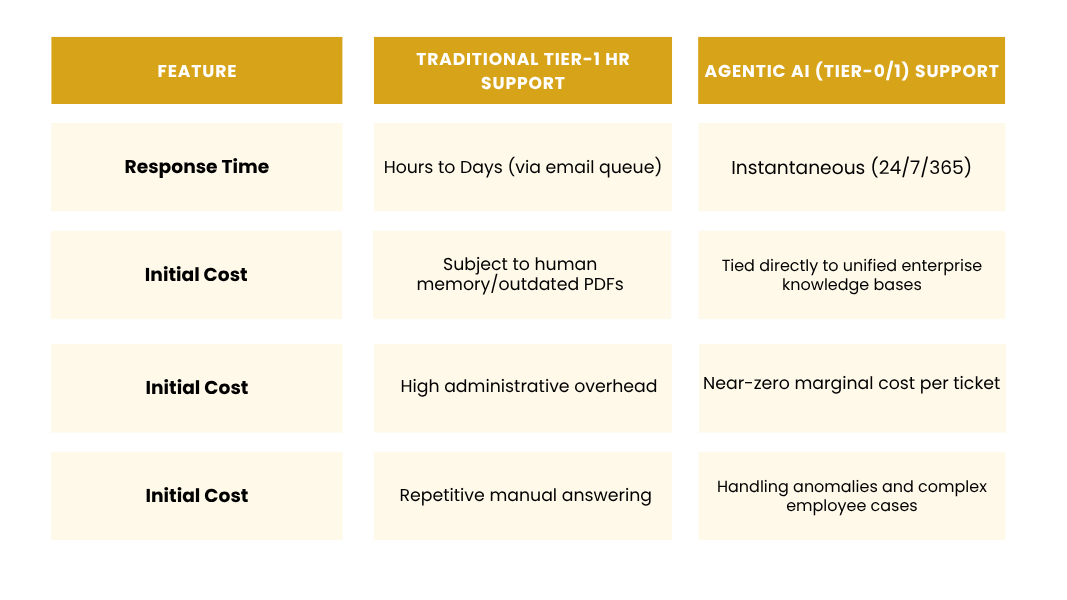
"Where do I find my tax documents?" "What is our parental leave policy?" and "How do I log an out-of-office request?" are just a few of the questions that the traditional HR department spends dozens of hours each month responding to. Employees who simply want a prompt response become irritated and HR teams are overworked as a result of this operational drag.
What AI Handles
Agentic HR assistants based on compliant Large Language Models (LLMs) are used in enterprise settings to manage Tier-0 and Tier-1 support. These tools do more than simply connect to a policy document; they also read the employee's particular data context, determine their precise remaining Paid Time Off (PTO) balance, compare it with team calendars, and handle the approval on their own. Basic employee support becomes completely frictionless.
Where Humans Become Critical
When routine policy questions are deflected by AI agents, human HR professionals are freed to handle complex, emotionally nuanced employee relations.
In a cross-functional team, an AI cannot arbitrate a delicate interpersonal dispute. It is unable to handle the complex legal and psychological issues that arise when an employee returns to work following a protracted medical leave or when they experience unexpected burnout at work. HR professionals can now devote unhurried, concentrated attention to human crises that call for profound empathy and moral judgement by delegating transactional queries to machines.
L&D is now a dynamic, customised ecosystem thanks to AI. Contemporary learning platforms serve hyper-personalized micro-learning modules directly within the work flow, analyse individual employee performance data, and instantly identify localised skill gaps. When an engineer comes across an unfamiliar code repository, for example, an AI tool might immediately recommend a three-minute technical guide.

3. Workforce Analytics & Attrition: Predictive Insights vs. Human Context
Data-driven HR is no longer limited to retrospective reporting—calculating last quarter's turnover rate and putting it into a slide deck. Predictive analytics engines now look forward, catching systemic workplace issues before they blow up.
What AI Handles
AI models are highly adept at identifying patterns of employee disengagement. By analyzing aggregated, anonymized digital signals—such as system login frequencies, communication volume drops, or PTO utilization patterns—predictive tools can flag teams or departments at high risk of regrettable attrition well before individuals submit formal resignations. It turns intuition into concrete data points.
Where Humans Become Critical
An AI can tell a Chief Human Resources Officer (CHRO) who is statistically likely to leave, but it cannot fundamentally explain why or fix the underlying cultural decay.
If an algorithm flags an attrition spike in a critical department, a human HR business partner must step in to investigate. Is the issue a toxic management style? Is it systemic burnout caused by unrealistic project scopes? Or is it a lack of perceived career progression? Resolving these issues requires qualitative exploration—conversations, trust-building, and organizational interventions—that sit entirely outside an algorithm's capability.
How HR Professionals Can Future-Proof Their Careers
If you are an HR generalist or coordinator looking at the landscape, the path forward requires a deliberate evolution of your skillset. The professionals who thrive will treat technology as a powerful collaborator rather than an existential threat.
1.Develop Basic AI Literacy:
Immediate Priority.
Understand the functional mechanics of the tools you use. You don't need to write Python code, but you must understand how data inputs influence algorithmic outputs, how to write precise prompts, and how to spot algorithmic bias or "hallucinations."
2.Pivot to People Analytics:
Months 1-3.
Move away from basic operational metrics (like headcounts) and learn to interpret complex data stories. Focus on measuring workforce readiness, skills density, and long-term talent retention outcomes.
3.Adopt an Agile Product Mindset:
Continuous Shift.
Stop viewing HR as a downstream policy enforcement function. Treat the employee experience as a living product. Ship initiatives faster, gather real user feedback, and iterate based on data rather than tradition.
The Bottom Line: AI will not replace HR professionals. However, HR professionals who use AI effectively will quickly replace those who do not. The future belongs to organizations that marry the speed and analytical depth of machine intelligence with the irreplaceable empathy and contextual judgment of human leadership.
Frequently Asked Questions
Will AI take away my HR job?
No. AI takes over repetitive tasks, not complete jobs. It handles things like sorting applications or answering basic policy questions. It leaves the complicated, emotional, and strategic work to human professionals.
Which HR roles are changing the most?
Entry-level jobs that focus mostly on manual data entry—like typing up payroll hours or manually tracking paperwork—are shrinking fast. Roles that focus on employee relations, company strategy, and tech management are growing.
Can an AI decide to fire me?
No, not legally. Software cannot make employment decisions that could change a person's life on its own, according to new privacy and AI laws. The final decision must always be made by an HR specialist or human manager after reviewing the data.
How can I tell if my hiring AI is biased?
AI learns from past hiring habits. If your company historically hired from only one background, the AI will copy that bias. HR teams have to regularly audit their tools to ensure the system is judging people on their current skills, not their demographic data.
Conclusion: A More Human Future for HR
The debate about whether AI belongs in HR is over—it's already here. But this isn't bad news for the profession. In fact, it's a huge upgrade.
HR professionals can finally return to their primary responsibility of assisting people in thriving at work by letting smart systems handle the administrative quicksand that used to slow everyone down. Businesses that use technology to make their workplace feel more connected, human, and supportive will be the ones that succeed in the future, not those with the most sophisticated code.