Keka vs. Clan: The Right HRMS for a 20-25 Person IT Firm
Running a boutique IT company, software agency, or startup with 20 to 25 employees puts you in a unique operational sweet spot. Your team is large enough that tracking leaves on a chaotic WhatsApp group, running payroll on an error-prone Excel sheet, and tracking projects on scattered Trello boards has become a massive time sink. Yet, your team is small enough that dropping a fortune on heavy, corporate enterprise software feels like absolute overkill.
When Indian tech founders look for a modern Human Resource Management System (HRMS), they usually face two contrasting options: Keka HR, the well-established giant of mid-market corporate HR automation, and Clan (clan.biz), an operational workspace explicitly built by an Indian software agency for small-to-medium Indian tech teams.
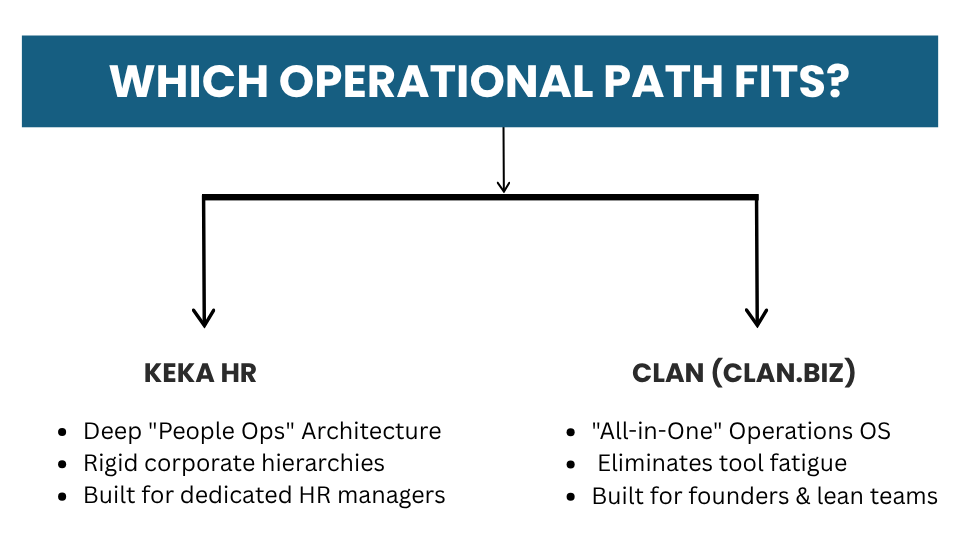
The Core Philosophy: "Enterprise HR Department" vs. "All-in-One Engineering Hub"
Before looking at specific features, it is critical to look at the core philosophy behind both products. Selecting a tool that matches your operational culture matters just as much as checking off a list of requirements.
Keka HR: The Traditional Corporate Infrastructure
Keka is designed with a traditional corporate environment in mind. It assumes your business has (or will soon have) a dedicated HR manager, structured administrative hierarchies, and a need for complex, hyper-customizable policy parameters. It focuses deeply on HR isolation—meaning it handles the relationship between the employer and employee flawlessly, but it completely ignores the work that those employees are actually doing on a day-to-day basis.
Clan: The Frictionless Tech Team Workspace
Clan was built by Froiden Technologies (a 34-person tech firm based out of Jaipur) out of sheer operational frustration. Like most small IT businesses, they were trapped in "tool fatigue"—juggling greytHR for payroll, biometric devices for the door, Trello for tasks, Google Docs for OKRs, and WhatsApp for leave requests.
Clan’s entire philosophy is consolidation: bring HR, Indian statutory payroll, project task tracking, and performance OKRs into a single login. It is built to keep developer disruption to a minimum by matching the casual, high-velocity workflow of a modern tech startup.
1. Attendance & Shift Management: Portal Logins vs. Ecosystem Flexibility
For a 20- 25-person IT company, tracking attendance isn't about micromanagement; it is about gathering accurate data for client billing, resource forecasting, and payroll synchronisation.
Keka’s Compliance-Driven Approach
Keka offers a highly structured, rigid tracking suite. It features biometric integration via APIs, mobile geo-fencing, IP restrictions, and selfie-based check-ins. If your IT company runs round-the-clock rotational tech support shifts or requires deep compliance trails for security audits, Keka’s shift roster management handles complex configurations effortlessly.
However, it requires employees to consistently open a dedicated app or portal to log their day, which can introduce administrative friction into a relaxed tech environment.
Clan’s Dev-Centric Workflow
Clan simplifies attendance by combining modern hardware tracking with native team messaging tools:
Anti-Spoofing Face Verification: Employees can clock in directly from their smartphones using face verification that prevents "buddy punching."
Biometric Integration: It syncs directly with existing biometric office hardware out of the box, feeding data straight into payroll without manual uploads.
Automated WhatsApp Alerts: Clan sends a daily attendance summary directly to your designated WhatsApp group. Instantly see who has checked in, who is working remotely, and who is on leave—keeping your entire 20-person team informed without needing to log into another system.
2. Leave Approvals: The WhatsApp Factor
How much time does your management team lose chasing leave approvals? In a small company, creating heavy corporate barriers around simple time-off requests can stifle workplace agility.
Keka: The Structured Portal Lifecycle
In Keka, an employee logs into the self-service web or mobile portal, submits a leave request, and specifies the exact category (e.g., casual, earned, or sick leave). The system routes this request through a multi-level managerial approval tree. While reliable, it treats every single leave request with a corporate gravity that can feel slow and disconnected for an agile 20-person startup.
Clan: The 10-Second WhatsApp Approval
Clan is aware that instant messaging is the main means of communication for smaller tech teams. Clan immediately notifies the manager via WhatsApp when an employee requests a leave of absence.
The manager only needs to tap "Approve" or "Reject" in WhatsApp. Leave balances are automatically synchronised with payroll records, and the employee receives an instant update. There are no needless follow-ups or administrative delays because the entire process only takes a few seconds.
3. Indian Payroll & Statutory Compliance: A Dead Heat
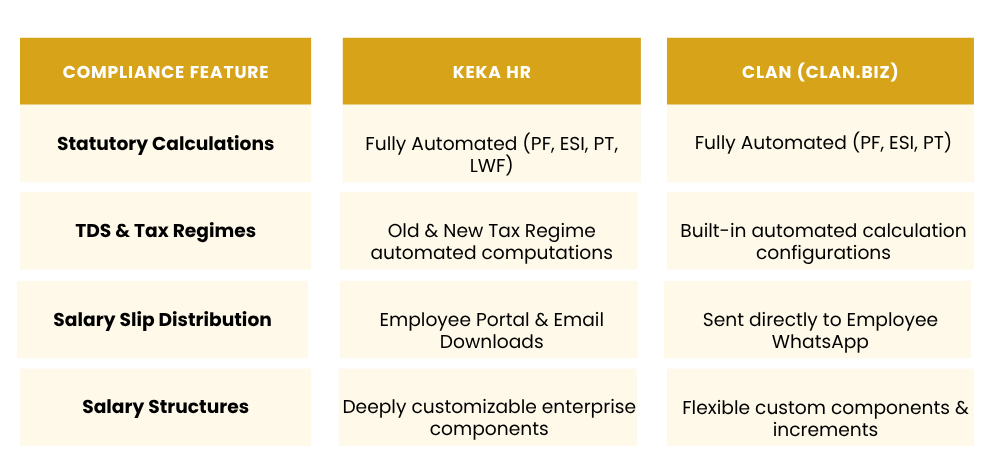
When it comes to processing salaries in India, making manual calculation errors with Provident Fund (PF) allocations, Employee State Insurance (ESI), Professional Tax (PT), or Tax Deducted at Source (TDS) can lead to unexpected compliance penalties.
The Keka Payroll Engine
Keka is an industry gold standard for payroll compliance. It processes variable salary components, handles complex tax declarations under both old and new regimes, manages investment proof verifications, and generates bank-ready transfer sheets seamlessly. It is an incredibly powerful engine, though configuring it initially often requires navigating through dense arrays of settings.
The Clan Payroll Engine
Clan matches Keka stride-for-stride on Indian compliance because it was built specifically for local companies. Attendance logs and approved leaves flow directly into the payroll module with zero manual reconciliation.
Where Clan innovates is the final step: it delivers payslips directly to your employees' WhatsApp. Your engineers can view, verify, and store their monthly salary slips instantly without having to remember portal passwords or hunt through cluttered email inboxes.
4. Project Management: Siloed Systems vs. Built-In Context
This is where the distinction between the two platforms becomes incredibly clear for an IT service provider, software consultancy, or development shop.
Keka’s Isolation
Keka tracks time, not tasks. It features a timesheet module where employees can manually enter how many hours they spent on a specific project code. However, Keka has no idea what tasks are actually inside that project. It cannot tell you if a milestone is slipping, who is facing a deployment bottleneck, or what bugs are blocking a release. You still have to pay for and maintain separate task trackers like Jira, ClickUp, or Asana.
Clan’s Native Integration
Clan features a built-in project and task management ecosystem. Right alongside their leave balance and attendance trackers, your team has access to visual task assignments, deadlines, and project collaboration pipelines.
For a 20-25 person IT firm, this unification is invaluable. A project manager can look at a project board, notice a timeline delay, cross-reference it immediately with an team member's approved leave calendar, and reassign the task—all within the exact same software environment.
5. Performance Reviews: Complex Appraisals vs. Goal-Driven OKRs
Retaining talented software developers requires clear, transparent feedback. However, small companies rarely have the time or patience to fill out overly corporate, multi-page appraisal forms.
Keka’s 360-Degree Appraisals
Peer-to-peer reviews, multi-tier manager evaluations, continuous feedback, and highly structured appraisal cycles are all supported by Keka. Keka offers a very thorough framework if your company requires formal, HR-driven evaluation structures. However, these lengthy, intricate forms can easily become an administrative burden that developers attempt to avoid for a small team of 20.
Clan’s Transparent OKR Boards
Clan skips the corporate jargon and implements Objectives and Key Results (OKRs) linked to structured 1:1 meetings.
Clan Performance Flow:
Company OKR ──> Team OKR ──> Individual Goals ──> Structured 1:1 Agendas
Management can cascade overarching company goals down to specific development teams and individual engineers. Because everything lives on the same dashboard where developers mark attendance and track daily tasks, your company goals remain highly visible and relevant, rather than being buried away inside a forgotten Google Doc.
6. Financial Analysis: The Bootstrapped Startup vs. VC-Backed Cost Structure
For a small, scaling company, managing software subscriptions carefully is vital for maintaining healthy cash flow margins. Let's look at the actual math behind deploying these platforms for a 25-person team.
The Keka Pricing Reality: The "Minimum Headcount Trap"
Keka uses a tier-based minimum pricing model designed for mid-market businesses.
Their baseline Foundation Plan typically starts around ₹6,999 per month.
This package covers up to 100 employees. Because they do not offer a smaller, specialized tier for tiny teams, your 25-person company is effectively forced to pay for 75 empty seats you aren't using yet.
If you want to add advanced features like performance tracking or OKRs, you must move up to their higher tiers (Strength or Growth), scaling your monthly software bill significantly.
The Clan Pricing Reality: Honest, Pay-As-You-Grow Pricing
Clan is specifically priced to be within the reach of lean technology teams and expanding startups:
Free Tier: Totally free for groups of up to ten individuals (ideal for stealth startups in their early stages).
Growth Plan: The monthly fee for teams with more than ten members is just ₹89 per active employee.
By opting for Clan, you save thousands of rupees every single month compared to Keka's baseline cost. On top of that, because Clan includes native project management and OKRs out of the box, you can cancel your external Trello or Asana subscriptions, saving your business even more operational capital.
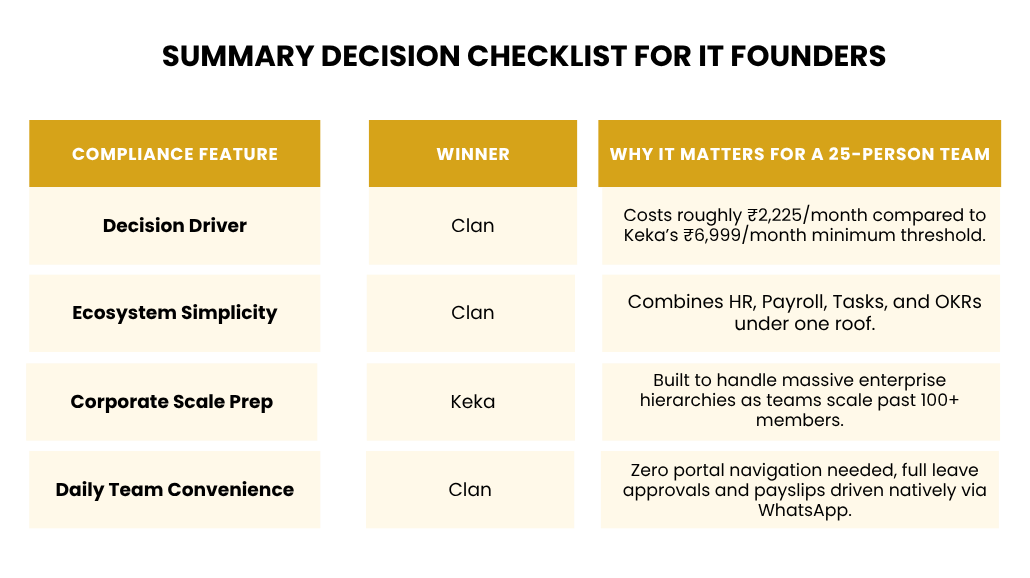
The Ultimate Verdict: Which Tool Should You Choose?
Both systems are excellent, but they serve completely different operational styles. Use this direct summary guide to make your final decision.
Choose Keka HR if:
You have an independent HR Manager: To manage corporate policies, your company's committed HR executive requires a separate, industry-standard ecosystem.
You're scaling quickly: You want to establish strict corporate hierarchies early because you anticipate growing from 25 to more than 150 employees over the course of the next 12 months.
You need hyper-customized shift configuration: Your software firm runs strict, overlapping, multi-country rotational shifts that require intricate biometric enforcement rules.
Choose Clan if:
You want to eliminate tool fatigue: You want to consolidate your HR, payroll compliance, project tracking, and OKRs into a single system with one login and one monthly bill.
You want a developer-friendly culture: You want to minimize administrative overhead by letting your team check attendance on Slack and approve leaves instantly over WhatsApp.
You want to pay for what you actually use: You want to avoid paying for empty corporate seat minimums and prefer an affordable, pay-as-you-grow pricing structure built for smaller teams.