Diwali Bonus vs Statutory Bonus in India: What Your Company Actually Owes
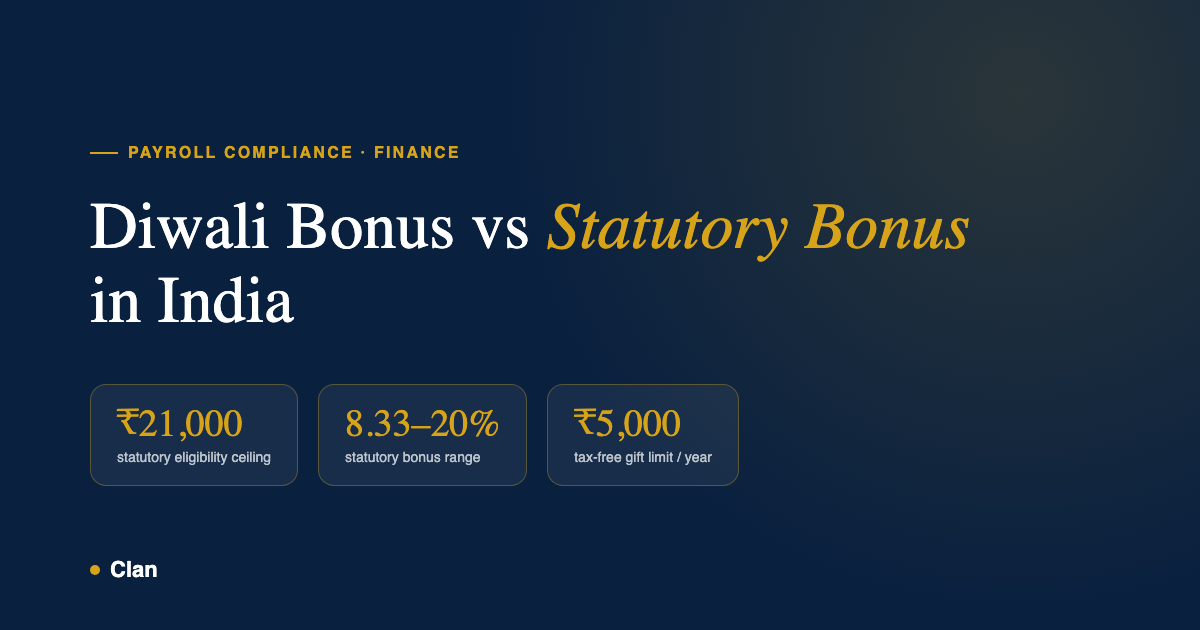
₹21,000 a month is the line that decides whether your company is legally on the hook for a bonus this Diwali. The gift hamper or Amazon voucher you're budgeting separately has nothing to do with that line — and conflating the two is the single most common bonus mistake at small Indian companies every October.
Every HR team at a 10-150 person tech company runs into this the same way: someone in finance asks "did we pay the bonus this year?", and the honest answer is "we gave everyone a ₹5,000 gift card," which is not an answer to the question that was actually asked. Two entirely different obligations are being discussed as if they were one.
Two bonuses, one word
The statutory bonus is a legal payment under the Payment of Bonus Act, 1965 — now Chapter VIII of the Code on Wages, 2019, in force since 21 November 2025. If your company has 20 or more employees and an employee earns up to the eligibility ceiling and has worked at least 30 days in the accounting year, you owe it. There's no opting out, no "we're a startup" exemption, and no substituting it with something else.
The Diwali bonus — sometimes called a festival bonus, ex-gratia payment, or performance bonus — is whatever your company decides to hand out around Diwali. There is no law that requires it, no formula that governs it, and no ceiling on it. It's pure policy.
Both get called "bonus" in casual conversation. Only one of them is enforceable.
| | Statutory Bonus | Diwali / Festival Bonus |
|---|---|---|
| Legal basis | Payment of Bonus Act / Code on Wages, Ch. VIII | None — company policy only |
| Who must pay it | Employers with 20+ employees | Nobody is required to |
| Who's covered | Employees earning up to ₹21,000/month (Basic + DA) | Whoever the policy names |
| Amount | 8.33% minimum to 20% maximum of a capped calculation base | Any amount the company decides |
| Calculation base | Lower of ₹7,000/month or actual Basic + DA (or the applicable minimum wage, if higher) | Not applicable |
| Minimum service to qualify | 30 days in the accounting year | Whatever the policy states |
| Payment deadline | Within 8 months of the accounting year's close (30 November for an April-March year) | Whenever the company chooses |
| Can one replace the other? | No | No |
Who you actually owe the statutory bonus to
This is where most of the confusion starts, because the law uses two different rupee figures for two different purposes, and it's easy to assume there's only one.
- Eligibility ceiling: ₹21,000/month. This decides who is covered. It moved up from ₹10,000 via a Ministry of Labour & Employment notification, S.O. 4711(E), issued 25 August 2026 — but given retrospective effect to 21 November 2025, the date the Code on Wages itself took effect. If an employee's Basic + DA is ₹21,000/month or below, they're in scope. Above that, the statutory bonus doesn't apply to them at all — though nothing stops a company from giving them a discretionary one.
- Calculation ceiling: ₹7,000/month. This decides how much. Even though eligibility is checked against actual salary up to ₹21,000, the bonus itself is calculated on a maximum of ₹7,000/month — or the state's applicable minimum wage for that role, if that figure is higher than ₹7,000. This is genuinely counterintuitive: an employee earning ₹20,000/month and one earning ₹7,500/month can be legally entitled to the exact same rupee bonus, at the same percentage, because both get capped at the same calculation base.
> A ₹5,000 Diwali gift card doesn't excuse a company from the statutory bonus it owes a ₹19,000/month employee — one is a compliance obligation with a fixed floor, the other is a goodwill gesture with no floor at all. Treating them as interchangeable is how a genuine Payment of Bonus Act violation ends up hiding behind a perfectly generous-looking festival gesture.
Worked example. Take an employee whose Basic + DA is ₹18,000/month — eligible, since that's under ₹21,000. The calculation base is capped at ₹7,000/month regardless, so the annual calculation base is ₹7,000 × 12 = ₹84,000. At the statutory minimum of 8.33%, the company owes at least ₹6,997 for the year — payable even if the company made no profit at all. If allocable surplus supports it, that can rise up to 20%, or ₹16,800. Either figure is separate from, and payable in addition to, any Diwali gift the same employee receives.
Why the gift card has its own tax trap
Here's the part that catches finance teams who think they've been generous and careful: cash is always fully taxable, and non-cash gifts are only tax-free up to ₹5,000 a year, in aggregate.
Under Rule 3(7)(iv) of the Income Tax Rules, 1962, gifts, vouchers, or tokens an employer gives an employee are exempt from tax only if their combined value across the entire financial year stays at or below ₹5,000. Cross that line by even ₹1, and the exemption doesn't just fail for the excess — the entire amount becomes taxable as a salary perquisite, not just the part above ₹5,000.
This is where a well-meaning HR calendar backfires. A ₹3,000 Diwali voucher feels harmless. Add a ₹2,500 work-anniversary gift card earlier in the same year, and the ₹5,500 total is now fully taxable — the employee owes tax on all ₹5,500, not the ₹500 over the limit. Most companies don't track cumulative gift value across the year at all, which means this crosses the line quietly and shows up as a payroll TDS correction months later.
A few things that follow from this, worth putting in writing as policy rather than leaving to whoever's ordering gift cards that quarter:
1. Cash bonuses, of any size, are fully taxable from the first rupee — statutory or discretionary, there's no exemption to reach for.
2. Non-cash gifts only stay tax-free if the whole year's total is ≤ ₹5,000 — track every gift-card, hamper, and voucher against one running total per employee, not per occasion.
3. The statutory bonus and the tax-free gift limit are unrelated numbers — don't let "we're under ₹5,000 on gifts" create the impression that the ₹21,000/₹7,000 statutory bonus math has also been handled.
Building this into an actual payout, not a guess
None of this needs to be recalculated by hand every October if it's structured once, correctly:
- Confirm which employees fall under the ₹21,000/month eligibility ceiling and flag the 30-days-worked threshold for anyone who joined mid-year.
- Run the statutory number through the capped ₹7,000 base at whatever percentage the company has committed to (8.33% minimum), separately from any Diwali budget.
- Decide the discretionary Diwali amount as its own line item, in cash or kind, and track its cumulative value against the ₹5,000 gift-tax threshold if it's non-cash.
- Pay the statutory portion by the deadline — 30 November for a standard April-March accounting year — regardless of when the festive gift goes out.
Clan's payroll plans (see clan.biz/pricing) track bonus eligibility, the accounting-year statutory run, PF, ESI, and gratuity off the same employee record, so this doesn't turn into a spreadsheet reconciled once a year under deadline pressure. For the exact statutory rupee figure at a given salary, run it through clan.biz/bonus-calculator rather than estimating — it applies the ₹7,000 calculation ceiling and the 8.33%-20% range automatically.
The two bonuses will keep sharing a name in every hallway conversation this Diwali. They don't share a legal basis, a formula, or a tax treatment — and a company that's generous on one can still be in violation on the other.
Topics