Gratuity Calculation in India (2026): Formula, Eligibility & the New Wage Rule
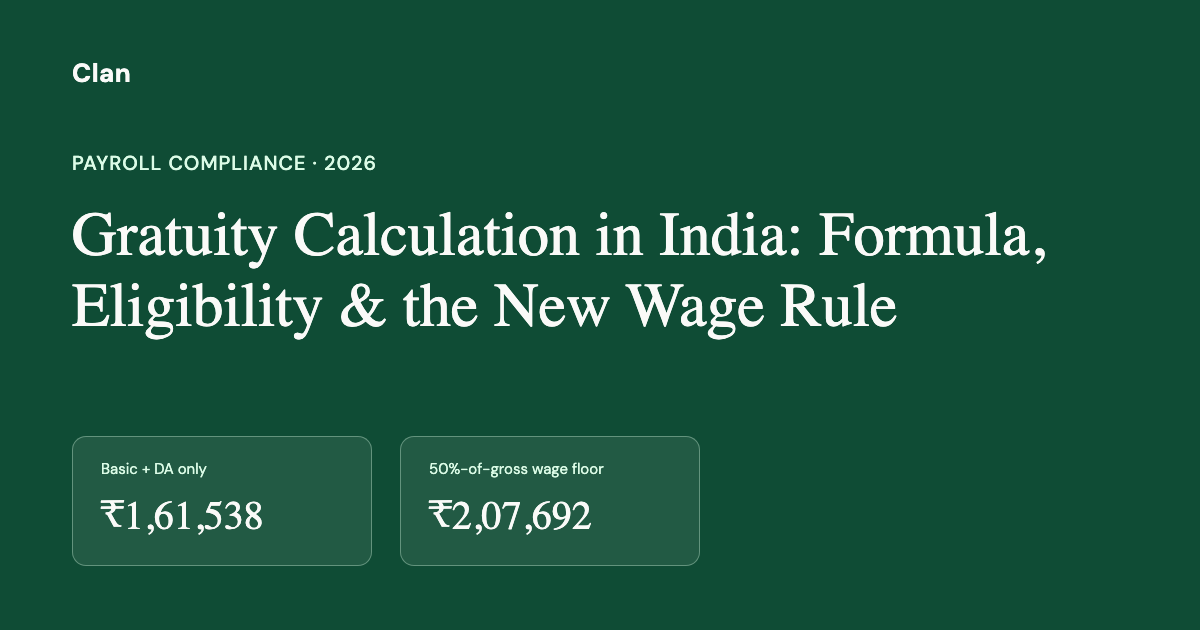
Run a ₹35,000 basic salary through the standard gratuity formula for eight years of service and you get ₹1,61,538. Run the same employee's actual pay — ₹90,000 gross, structured with a low basic and a large "special allowance" — through the wage-floor rule the labour codes introduced, and the number becomes ₹2,07,692. That's a ₹46,154 gap on one employee, and most payroll spreadsheets at 10-150 person companies are still calculating the smaller number.
Gratuity is one of those statutory payments HR teams "know" until someone actually leaves and the number has to be exact — for a final settlement, a resignation acceptance letter, or a dispute. It hasn't been simple since the labour codes took effect on 21 November 2025. Two things changed at once: who qualifies, and what counts as "wages" in the formula. Getting either wrong means either underpaying a departing employee or under-provisioning for exits company-wide.
The formula itself hasn't changed
Gratuity is still calculated the same way it always was, under the Payment of Gratuity Act, 1972:
> Gratuity = (Last drawn wages × 15 × completed years of service) ÷ 26
Fifteen represents half a month's wages for each year served. Twenty-six is the assumed number of working days in a month. "Wages" here means Basic + Dearness Allowance only — not HRA, not bonus, not commission, not most other allowances. That definition of wages is exactly what the labour codes tightened, and it's where the real change sits.
Years of service round in the employee's favour, not down. If completed service crosses 6 months into the next year, it rounds up to a full year for the calculation. An employee who served 7 years and 7 months is treated as 8 years. One who served 7 years and 5 months stays at 7. That six-month line is worth knowing before an exit conversation, because it can change the final number more than a small salary difference would.
Who actually qualifies
The default eligibility rule is unchanged: 5 years of continuous service, whether the employee resigns, retires, or is terminated for reasons other than misconduct. Two things are different now:
1. Fixed-term employees get gratuity after just 1 year of continuous service, on a pro-rata basis — a new labour-code provision, not a Payment of Gratuity Act rule, and it only applies where the fixed-term contract started on or after 21 November 2025. A company still running fixed-term hires under contracts signed before that date isn't covered by the exception yet.
2. Death or disablement waives the minimum service requirement entirely. Even six months of service qualifies if the employee dies in service or is medically disabled from continuing work. This exception existed under the old Act too — it isn't new — but it's the one HR teams most often forget under pressure, because it's the least common exit reason.
The wage-floor rule, and why it matters more than eligibility
This is the change that actually moves money. The labour codes' definition of "wages" now requires that Basic + DA make up at least 50% of total remuneration. If a company's CTC structure pushes basic below that line — a common way to keep the PF and gratuity base low — the shortfall gets added back before the gratuity formula runs. In effect: if 50% of gross pay is higher than the stated Basic + DA, that 50%-of-gross figure becomes the wage used in the calculation instead.
This closes a gap a lot of CTC structures were built around. A ₹90,000/month gross salary with only ₹35,000 basic used to mean gratuity was calculated on ₹35,000. Now the calculation uses whichever is higher — Basic+DA, or 50% of gross — so it runs on ₹45,000 instead. Worked through the formula for 8 completed years:
| | Basic + DA only (old approach) | 50%-of-gross wage floor (current rule) |
|---|---:|---:|
| Wage used in formula | ₹35,000 | ₹45,000 |
| Years of service | 8 | 8 |
| Gratuity payout | ₹1,61,538 | ₹2,07,692 |
| Difference | — | +₹46,154 |
Neither number is wrong for its own rule set — the second one is just the one that's legally correct today. Any company whose CTC structure leans on allowances to keep the "cost" line low on paper should re-run its actual exit liability, not assume last year's numbers still hold.
The eligibility change at a glance
| | Before the labour codes | Since 21 Nov 2025 |
|---|---|---|
| Regular employee minimum service | 5 years | 5 years — unchanged |
| Fixed-term employee minimum service | 5 years | 1 year, pro-rata (new contracts only) |
| Death or disablement | No minimum | No minimum — unchanged |
| Wage used in formula | Basic + DA as structured | Basic + DA, or 50% of gross, whichever is higher |
| Tax-free ceiling (Section 10(10)) | ₹20,00,000 | ₹20,00,000 — unchanged |
The tax treatment is the one thing that stayed exactly where it was: gratuity up to ₹20 lakh remains exempt from income tax for private-sector employees. Above that, the excess is taxable as salary income in the year it's received. Most 10-150 employee companies will never see an exit anywhere near that ceiling — it starts to matter at senior, long-tenure exits, not entry- or mid-level ones.
Where gratuity fits into the actual exit process
Gratuity rarely gets calculated in isolation — it's one line in a full and final settlement that also includes leave encashment, notice-period recovery or pay-in-lieu, and any pending reimbursements. And the settlement itself now has its own deadline: the labour codes require full and final dues to be paid within 2 working days of an employee's last working day, down from the loose "within 30-45 days" convention many companies still operate on informally.
That combination — a shorter payment window, and a wage definition that can quietly increase the payout — is why exit calculations are worth automating rather than rebuilding in a spreadsheet each time someone resigns. Clan's Offboarding workflow (the same module that handles asset return and access revocation on an exit) is where the full and final settlement gets computed, so the gratuity figure isn't a separate side calculation someone has to remember to reconcile against payroll before the final payment goes out.
If you want to check a specific employee's number without touching payroll, clan.biz/gratuity-calculator runs the exact logic above — enter joining date, last working date, employment type, and last-drawn Basic+DA and gross, and it applies both the eligibility rule and the 50%-of-gross wage floor automatically, then shows you the tax-exempt and taxable portions separately. For the rest of the exit math — leave encashment, notice period, deductions — clan.biz/full-and-final-settlement-calculator covers the full F&F payout in one place.
What to check before your next exit
- Confirm which employees are on fixed-term contracts signed on or after 21 November 2025 — they're now gratuity-eligible after 1 year, and payroll may not be flagging them yet.
- Re-check any CTC structure where Basic + DA is well under 50% of gross. The wage floor applies at calculation time regardless of what the offer letter says, so it's better to know the real number before an exit than to discover it during one.
- Build the 2-working-day F&F deadline into your offboarding checklist, not just the gratuity number in isolation — a correct gratuity figure paid late is still a compliance miss.
None of this is a one-time fix. The wage-floor rule in particular will keep surfacing as long as CTC structures are built the old way, so it's worth a standing line item in your next salary-structure review rather than something to patch only when someone resigns.