Old vs New Tax Regime in FY 2026-27: What Actually Saves More
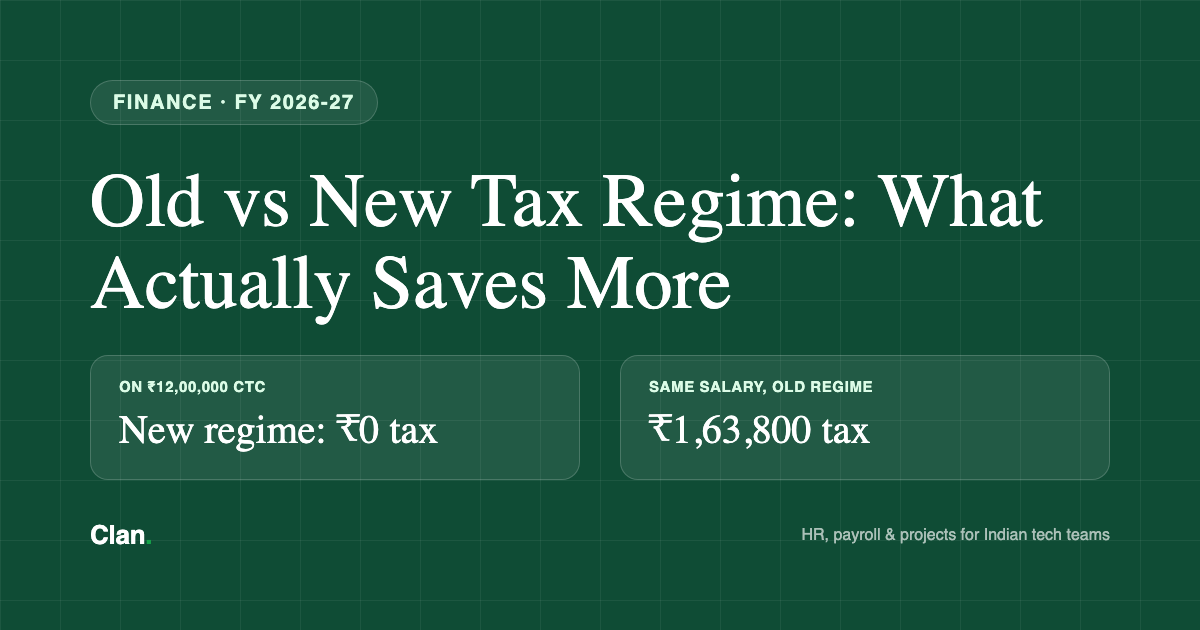
An employee on a ₹12,00,000 CTC with zero tax-saving investments pays nothing under the new regime this year. Run the same salary through the old regime and they owe roughly ₹1,64,000. That gap alone is why "new regime by default" isn't just a payroll technicality anymore — it's real money, and most HR teams still explain it wrong to new joiners.
Nothing changed for salaried taxpayers in the FY 2026-27 Union Budget — the slabs, standard deductions, and rebate thresholds carried over unchanged from FY 2025-26. That's worth stating plainly, because every tax season a fresh wave of "what changed this year" searches assumes there's a new number to learn. There isn't. What's actually changed is that enough time has passed since the 2025 overhaul that the old assumption — "old regime wins if you have HRA and 80C" — has quietly stopped being true for most people at a 10-150 employee tech company.
The two slab structures, side by side
New regime (default for TDS unless an employee opts out):
| Taxable income slab | Rate |
|---|---|
| Up to ₹4,00,000 | Nil |
| ₹4,00,001 – ₹8,00,000 | 5% |
| ₹8,00,001 – ₹12,00,000 | 10% |
| ₹12,00,001 – ₹16,00,000 | 15% |
| ₹16,00,001 – ₹20,00,000 | 20% |
| ₹20,00,001 – ₹24,00,000 | 25% |
| Above ₹24,00,000 | 30% |
Standard deduction: ₹75,000. Section 87A rebate wipes out tax entirely when taxable income is ₹12,00,000 or below — which, added to the standard deduction, means a salary-only earner can take home up to roughly ₹12,75,000 in gross pay before owing a rupee, provided they have no other deductions to claim (and none are needed under this regime).
Old regime (opt-in, via Form 10-IEA):
| Taxable income slab | Rate |
|---|---|
| Up to ₹2,50,000 | Nil |
| ₹2,50,001 – ₹5,00,000 | 5% |
| ₹5,00,001 – ₹10,00,000 | 20% |
| Above ₹10,00,000 | 30% |
Standard deduction: ₹50,000. Section 87A rebate here is much smaller — capped at ₹12,500, and only for taxable income up to ₹5,00,000. Everything above that runs on the slabs above, minus whatever HRA, Section 80C (up to ₹1,50,000 combined with employee PF), and Section 80D an employee actually claims.
> The old regime's rebate cliff sits at ₹5L taxable income. The new regime's sits at ₹12L. That 2.4x wider zero-tax zone is doing most of the work in why the new regime wins as often as it does now — not the lower top-end rate.
What it actually looks like on real salaries
Using the same calculation logic as Clan's own salary TDS calculator — full slabs, standard deduction, and rebate applied exactly as above — here's the tax bill at a spread of CTC levels for an employee claiming no HRA, 80C, or 80D deductions (a realistic baseline for a younger employee without a home loan, insurance premiums, or ELSS investments yet):
| Annual gross | Old regime tax | New regime tax | New regime saves |
|---|---|---|---|
| ₹6,00,000 | ₹23,400 | ₹0 | ₹23,400 |
| ₹8,00,000 | ₹65,000 | ₹0 | ₹65,000 |
| ₹10,00,000 | ₹1,06,600 | ₹0 | ₹1,06,600 |
| ₹12,00,000 | ₹1,63,800 | ₹0 | ₹1,63,800 |
| ₹15,00,000 | ₹2,57,400 | ₹97,500 | ₹1,59,900 |
| ₹18,00,000 | ₹3,51,000 | ₹1,50,800 | ₹2,00,200 |
| ₹25,00,000 | ₹5,69,400 | ₹3,19,800 | ₹2,49,600 |
At every one of those levels, the new regime wins — and not by a small margin. That's the baseline case, and it's the one most employees without a home loan or serious insurance/ELSS habit actually fall into.
Now the more interesting question: does the old regime ever catch up once someone claims the maximum they legally can — full ₹1,50,000 under 80C, ₹1,00,000 under 80D, and a large HRA exemption from a genuinely high metro rent?
| Annual gross | Old regime tax (max 80C + 80D + HRA) | New regime tax | New regime saves |
|---|---|---|---|
| ₹10,00,000 | ₹50,440 | ₹0 | ₹50,440 |
| ₹15,00,000 | ₹1,73,160 | ₹97,500 | ₹75,660 |
| ₹18,00,000 | ₹2,66,760 | ₹1,50,800 | ₹1,15,960 |
| ₹25,00,000 | ₹4,85,160 | ₹3,19,800 | ₹1,65,360 |
Still new regime, even with every common deduction maxed out. The crossover only shows up at the higher end of the income range this site's audience typically hires into — a senior engineering leader or founder-level salary, paired with a genuinely large metro rent. Model a ₹40,00,000 gross salary with a basic of ₹20,00,000, monthly rent of ₹1,25,000, and both 80C and 80D maxed, and the old regime finally wins: roughly ₹6,47,400 versus ₹7,87,800 under the new regime, a saving of about ₹1,40,000 a year. That's a specific, narrow case — high basic, high metro rent, maximum 80C/80D — not the median employee at a 10-150 person company.
One factor this comparison leaves out deliberately: home loan interest under Section 24(b), which can add up to ₹2,00,000 more in old-regime-only deductions for a self-occupied property. Clan's salary TDS calculator doesn't model that input yet, so if a chunk of your team has home loans, treat the old-regime numbers above as a floor, not the final answer for them specifically.
What this means for payroll, not just the employee
Since the 2023 Budget, the new regime is the default for TDS purposes. If an employee doesn't submit a regime declaration, payroll deducts tax under the new regime automatically. An employee who wants the old regime has to actively opt in — for a salaried employee, that's a declaration to the employer at the start of the year (and can still be changed at ITR filing time via Form 10-IEA, independent of what payroll withheld through the year).
This creates a real HR problem that has nothing to do with the tax math itself: most declaration forms still ask "which regime do you want?" without showing the employee what either answer actually costs them. Given the tables above, a chunk of employees who reflexively tick "old regime" because they have some HRA and an LIC premium are quietly overpaying TDS all year, then chasing a refund at filing time instead of taking home more every month.
Where Clan already handles this
Clan's salary TDS calculator runs both regimes side by side on the same inputs — gross salary, HRA, rent, 80C, 80D — and shows the exact rupee difference before an employee declares a regime, instead of a generic "new regime is usually better" disclaimer. It's the same slab logic and rebate rules used for every number in this post. Run your own team's numbers at clan.biz/salary-tds-calculator, or a full CTC-to-take-home breakup at clan.biz/salary-calculator.
Payroll teams juggling this declaration cycle alongside PF and ESI thresholds for a mixed-experience team can check both together with the compliance checker at clan.biz/compliance-checker.
This isn't tax advice for any individual's specific filing — a home loan, capital gains, or multiple income sources change the math beyond what's modelled here. For anything beyond a straightforward single-salary comparison, that's still a conversation for a CA. Book a 15-minute walkthrough of how Clan handles regime declarations on your own payroll at clan.biz/demo, or start free at clan.biz/pricing.