ESI Applicability and Contribution Rate in India (2026)
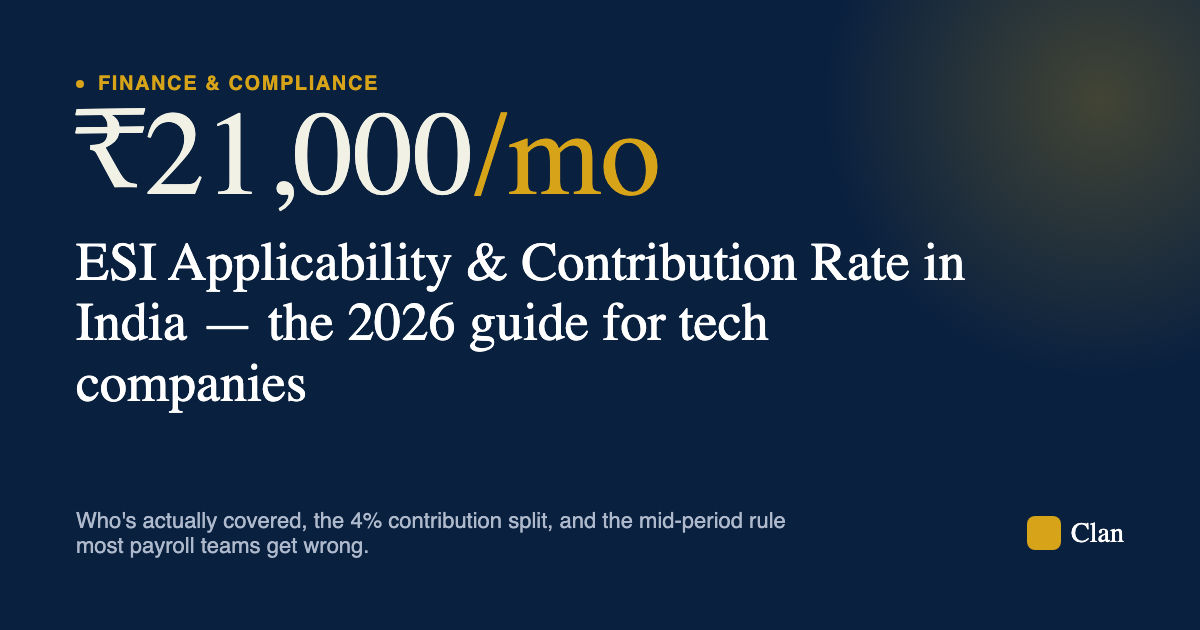
₹21,000 a month. That's the entire line that decides whether Employee State Insurance applies to any given person on your payroll — and at a 10-150 person tech company, it usually means ESI quietly doesn't apply to most of your engineering team at all, while it very much applies to your intern, your office admin, and the junior support hire you just onboarded at ₹18,000.
Most ESI explainers online are written for factories and large-scale manufacturing payrolls. They're not wrong, but they skip the one thing that actually matters for a software company: who on your specific team crosses the line, and what happens the month someone's salary pushes them over it.
What ESI actually is
Employee State Insurance is a social security scheme run by the Employees' State Insurance Corporation (ESIC), funded jointly by employer and employee contributions. In exchange, covered employees get access to medical care, sickness benefit, maternity benefit, and a few other cash benefits through ESIC-run dispensaries and hospitals. It is not optional once an employee qualifies — it is a statutory deduction, the same category as PF.
Does ESI apply to your company at all
ESI applies to non-seasonal establishments employing 10 or more persons (the threshold is 20 in a handful of states). "Establishment" under the Act has historically been interpreted broadly enough to cover shops, commercial establishments, and IT/ITES offices in most states that have extended the Act to them — not just factories. If you've already crossed the 10-employee mark and run payroll out of an Indian entity, assume ESI registration obligations apply and verify with your state's specific notification rather than assuming "we're software, so it doesn't apply to us." That assumption is one of the most common mistakes tech-company founders make, and it's the wrong one to be wrong about.
> The mistake isn't miscalculating ESI. It's assuming it doesn't apply to a software company at all — right up until an inspection asks why it was never registered.
The wage ceiling: this is the part that actually matters for you
Here's where it gets specific to a tech company's headcount shape. ESI only covers employees whose gross monthly wages are ₹21,000 or less (₹25,000 for employees with a disability). Gross wages here means basic + allowances actually paid out monthly — not CTC, and not including employer PF contribution or annual components like bonus paid separately.
At most 10-150 person tech companies, that ceiling splits your headcount cleanly:
| Role (illustrative) | Typical gross monthly wage | ESI applicable? |
|---|---|---|
| Intern / trainee | ₹12,000–₹18,000 | Yes |
| Office admin / housekeeping / support staff | ₹16,000–₹20,500 | Yes |
| Junior QA / junior support engineer | ₹19,000–₹21,000 | Often yes, right at the edge |
| Software engineer (even at entry level in most tech hubs) | ₹35,000+ | No |
| Any mid-to-senior role | ₹50,000+ | No |
The practical result: a 60-person SaaS company might have only 6-10 ESI-eligible employees — interns, support staff, housekeeping, drivers — even though the company is registered and the obligation applies to the whole establishment. Payroll teams that treat ESI as "something we don't need to think about because we're a software company" are usually the ones who miss the handful of people who genuinely are covered.
Contribution rates (unchanged since July 2019)
The split hasn't moved since ESIC last revised it:
| Contributor | Rate | Applied to |
|---|---|---|
| Employer | 3.25% | Gross wages, uncapped by the employee's own share |
| Employee | 0.75% | Gross wages |
| Total | 4% | Gross wages, up to the ₹21,000 ceiling |
So an employee drawing ₹20,000 gross contributes ₹150/month (0.75%), and the company contributes ₹650/month (3.25%) on top — a total statutory cost of ₹800/month for that one person, paid into ESIC, not into the employee's take-home.
One more detail that trips up manual payroll: employees whose average daily wage is ₹176 or below are exempt from the employee-side 0.75% contribution, though the employer still pays their 3.25% share. This mostly affects daily-wage or part-time support staff, not salaried software roles, but it's the kind of edge case that a spreadsheet built by someone who copied a formula from last year won't catch.
The rule almost nobody in tech-company HR gets right
ESI runs on fixed contribution periods — April to September, and October to March — rather than reacting to salary changes in real time. If an employee is covered at the start of a contribution period and then gets a raise that pushes their gross wage above ₹21,000 partway through, ESI coverage and the deduction continue until the end of that contribution period, not until the pay cycle after the raise.
This is the single most common payroll mistake on this topic: a support engineer gets appraised from ₹20,000 to ₹23,000 in, say, July, and the payroll team stops the ESI deduction the same month because "they're over the limit now." That's non-compliant. The correct handling is to keep deducting through September (end of the April-September period), and only drop them from ESI starting the October-March period if their wage is still above ₹21,000 at that point.
Get this backwards in either direction — stopping too early, or never restarting coverage for someone who dips back under the ceiling — and it surfaces as a discrepancy the next time ESIC cross-checks contribution filings against declared wages.
A worked example
Take a 40-person product company with this rough wage spread:
| Employee type | Headcount | Gross wage/month | Monthly employer ESI (3.25%) | Monthly employee ESI (0.75%) |
|---|---|---|---|---|
| Interns | 4 | ₹15,000 | ₹487.50 each | ₹112.50 each |
| Support/admin staff | 3 | ₹19,000 | ₹617.50 each | ₹142.50 each |
| Engineers, PMs, designers | 33 | ₹40,000+ | Not applicable | Not applicable |
Total monthly ESI outflow for this company: roughly ₹4,635 employer-side and ₹1,072.50 employee-side — on a 40-person payroll where fewer than a fifth of employees are even covered. That's a small, predictable number, but it only stays predictable if someone is tracking the ₹21,000 line per employee, per contribution period, every time a raise or a new hire happens.
How Clan handles this
Clan's payroll module checks each employee's gross wage against the ₹21,000 ceiling automatically every pay cycle and flags ESI eligibility per person rather than leaving it to a manual lookup — and it respects the contribution-period continuation rule above, so a mid-period raise doesn't silently (and incorrectly) stop a deduction early. For a growing tech company adding a few hires a month, that's one less compliance detail a founder or HR generalist has to track by hand on top of payroll, PF, and TDS. If you're currently calculating this in a spreadsheet, see clan.biz/pricing for what Growth-tier payroll includes, or book a demo to see the ESI eligibility flagging against your own current headcount.
Related reading
For the other statutory threshold that catches growing tech companies off guard, see our piece on when PF registration becomes mandatory at 20 employees. And if you're still estimating headcount cost using CTC alone, the real cost of an employee in India isn't the CTC you quoted walks through everything CTC doesn't show you — ESI and PF included.
Frequently asked questions
Does ESI apply to software/IT companies, or only factories?
Yes, in most states that have extended the Act to shops and commercial establishments, which includes the majority of states where Indian tech companies operate. Registration is based on employee count (10, or 20 in some states), not industry type.
If none of our employees earn under ₹21,000, do we still need to register?
If your establishment crosses the employee-count threshold, registration obligations generally still apply at the establishment level even if zero employees currently fall under the wage ceiling — because that can change the moment you hire an intern or a support role. Verify your specific state's position before deciding you're exempt.
Is ESI calculated on CTC or on gross wages?
Gross wages actually paid in the month — basic plus allowances paid out — not CTC, and not employer-side PF contribution.
What happens if we miscalculate or miss an ESI filing?
ESIC can levy interest and damages on delayed contributions, separate from any inspection findings on registration gaps. This is not a figure we'll state here without a verified current source — treat any specific penalty percentage you see elsewhere as something to confirm directly with ESIC or a compliance advisor before relying on it.