Leave Encashment Tax Exemption in India: The ₹25 Lakh Rule Most HR Teams Get Wrong
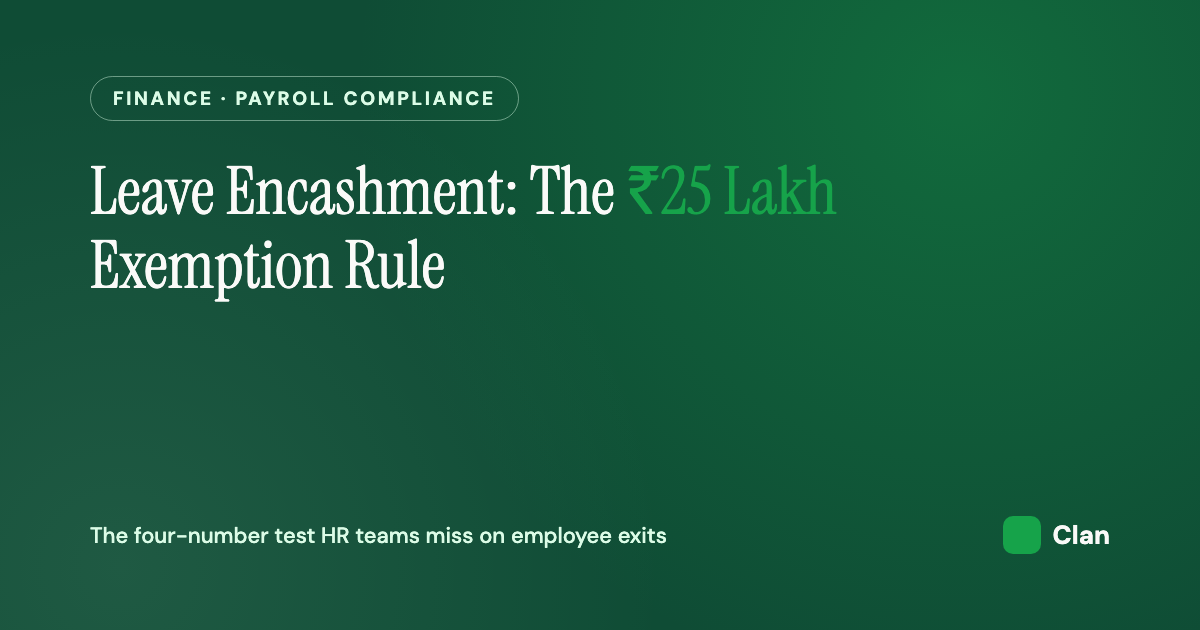
₹25,00,000. That's the lifetime cap on tax-free leave encashment for a private-sector employee in India — up from just ₹3,00,000 before Budget 2023. Most HR teams know the number exists. Fewer can walk an exiting employee through how much of their actual payout falls inside it.
That gap matters more than it looks. Get the calculation wrong on a departing employee's final settlement, and you've either overpaid TDS the employee has to claim back next ITR season, or under-deducted it and left them with a tax notice. Neither is a good way to end an employment relationship.
First: encashed while working, or encashed on the way out — these are taxed differently
Leave encashment isn't one tax rule. It's two, depending entirely on when the money is paid.
| When it's paid | Tax treatment |
|---|---|
| While still employed (company lets you encash unused leave annually) | Fully taxable as salary, no exemption at all |
| At retirement, resignation, or termination | Eligible for exemption under Section 10(10AA), subject to the formula below |
If your company runs an annual "encash your extra casual leave" policy, every rupee of that is salary income, full stop. The exemption only switches on when someone is actually leaving.
> The ₹25 lakh figure isn't what most employees actually get exempt. It's the ceiling. The real exemption is the lowest of four separate numbers — and for most mid-career employees at a 50-person tech company, one of the other three caps it well below that.
The four-number test
For an employee leaving the company, the exempt amount is whichever of these four is smallest:
| # | Component | How it's worked out |
|---|---|---|
| 1 | Actual leave encashment received | The cash amount your payroll actually pays out |
| 2 | Statutory leave cap | (Basic + DA ÷ 30) × 30 days of leave for every completed year of service — leave balance above 30 days/year of service doesn't count, even if your policy lets people carry forward more |
| 3 | 10-month average salary | Average of (Basic + DA + fixed commission, if any) over the 10 months immediately before the exit date |
| 4 | Lifetime ceiling | ₹25,00,000, minus any leave encashment exemption already claimed in a previous job |
Whatever is left over, above the exempt amount, gets added to the employee's salary income for that year and taxed at their slab rate.
A worked example
Take an employee leaving after 6 years, with a final Basic + DA of ₹60,000/month, a 10-month average salary (Basic + DA) of ₹58,000, and an accumulated leave balance of 90 days that the company is paying out in full.
- Actual encashment paid: ₹60,000 ÷ 30 × 90 = ₹1,80,000
- Statutory cap (30 days × 6 years = 180 days, but balance is only 90 days, so this doesn't bind): ₹60,000 ÷ 30 × 90 = ₹1,80,000
- 10-month average: ₹58,000 × 10 = ₹5,80,000
- Lifetime ceiling: ₹25,00,000
The lowest of the four is ₹1,80,000 — so in this case, the entire payout is exempt. Nothing added to taxable salary. The statutory cap only starts biting when someone has banked leave faster than 30 days a year, which is common at companies with generous carry-forward policies and employees who rarely take time off.
The nuance everyone misses: this one survives the new tax regime
HRA, LTA, and most Chapter VI-A deductions disappear if an employee opts into the new tax regime under Section 115BAC. Leave encashment exemption under Section 10(10AA) doesn't — it's one of the handful of exemptions (gratuity is another) that stays available either way.
That's worth saying out loud to exiting employees, because plenty of them assume moving to the new regime years ago means every exemption is gone. For a final settlement specifically, it isn't.
What this actually means for the person running payroll
A full and final settlement already has to net out notice pay, gratuity, unused leave, and any recoveries, inside the 2-working-day window the Code on Wages, 2019 pushes companies toward. Getting the leave encashment exemption wrong inside that window is an easy way to add a correction cycle to an exit that's supposed to be clean.
Three things worth getting into a standard offboarding checklist:
1. Pull the employee's 10-month average salary and years of completed service before calculating the payout, not after.
2. Ask whether the employee claimed any leave encashment exemption at a previous employer — the ₹25 lakh cap is lifetime, not per job, and it's on the employee to disclose it (most won't think to).
3. Don't apply the exemption to any leave encashed while the person was still actively employed earlier in the year — only the final payout at exit qualifies.
Clan's full and final settlement calculator (see clan.biz/full-and-final-settlement-calculator) runs leave encashment, gratuity, and notice recovery together into one number for exactly this reason — it's one calculation that has to use the same completed-service and average-salary inputs consistently, and doing it by hand in a spreadsheet is where the inconsistencies creep in.
FAQ
Does the ₹25 lakh limit apply per employer, or across a career?
Across a career. It's a lifetime ceiling across all employers, and the current employer is relying on the employee to disclose any amount already claimed exempt elsewhere.
Is encashment paid out at the end of each year taxable?
Yes, in full, as regular salary. The Section 10(10AA) exemption only applies to leave encashed at the time of leaving a job — retirement, resignation, or termination.
Does switching to the new tax regime affect this exemption?
No. Leave encashment exemption under Section 10(10AA) is available under both the old and new regimes, unlike HRA and LTA.
What if an employee's actual leave balance exceeds 30 days for every year of service?
Only 30 days per completed year of service counts toward the statutory cap (component #2 above), regardless of how much leave the company's own policy allowed them to carry forward.