The Real Cost of an Employee in India Isn't the CTC You Quoted
A ₹6,00,000 CTC offer rarely means a company pays exactly ₹6,00,000 for that employee over the year. By the time EDLI, an annual gratuity accrual, and the software the person actually logs into every day are added in, the real number is usually higher — and almost none of that gap shows up on the offer letter that got signed.
This isn't a story about hidden fees or bad-faith recruiters. It's simpler than that: CTC was designed to describe what an employee receives, not what an employer actually spends. Two or three genuinely statutory line items sit outside it by design, and most 10-150 employee companies only discover them the first time an auditor, a new finance hire, or a payroll vendor asks why the books don't reconcile with the offer letters.
Why CTC and "true cost" are different numbers
CTC — Cost to Company — bundles basic pay, allowances, and the benefits an employee can see and usually values: HRA, employer PF (in most modern Indian pay structures), a bonus component, sometimes insurance. It's built to answer the candidate's question: what will I actually get paid?
It was never built to answer the finance team's question: what does keeping this person on payroll actually cost us, every year, for as long as they stay? Those are different questions, and a few real costs only show up when you ask the second one.
The line items CTC usually leaves out
| Component | Formula | Usually inside CTC? |
|---|---|---|
| Employer PF | 12% of basic | Yes, in most modern Indian CTC structures |
| EDLI (EPFO insurance-linked scheme) | 0.5% of basic, capped at a ₹15,000 monthly wage base | Almost never shown separately |
| Gratuity accrual | ~4.81% of basic annually (the 15/26 formula as a yearly rate) | Rarely — it's a future liability, not a monthly payment |
| Employer ESI | 3.25% of gross wages | Only where it applies (gross ≤ ₹21,000/month) |
| Statutory bonus | 8.33-20% of a ₹7,000/month calculation base | Only where it applies (same ₹21,000/month ceiling) |
| Tools & software per employee | Whatever your actual stack costs | Almost never — usually sits in a separate IT/ops budget entirely |
For a typical salaried software engineer or manager at an Indian tech company, the ESI and bonus rows genuinely don't apply — both are gated at a ₹21,000/month gross wage ceiling that most tech salaries clear easily. They matter more for interns, support staff, or office administration roles paid closer to that line. But EDLI, gratuity accrual, and the tools line apply almost everywhere, regardless of seniority, and they're the ones a CTC-only budget consistently misses.
A worked example: ₹6,00,000 CTC
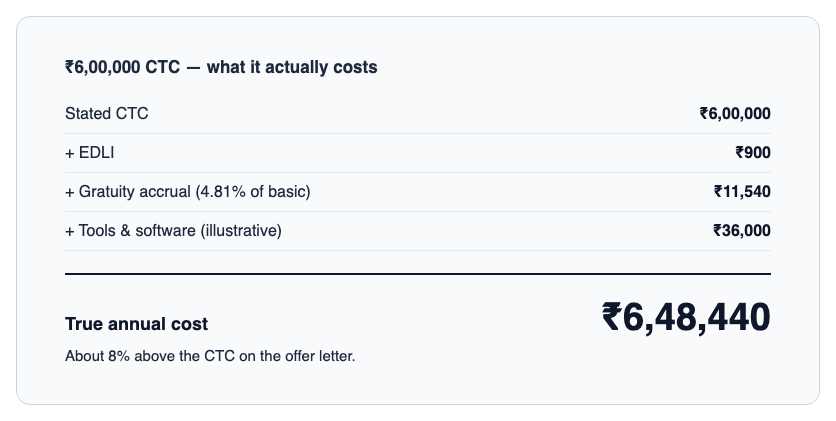
Take a ₹6,00,000 annual CTC with a 40% basic (₹2,40,000/year, or ₹20,000/month) — a fairly standard structure at a small Indian tech company.
- Employer PF: assume it's already folded into the ₹6,00,000 CTC, as is standard practice — no extra cost here.
- EDLI: 0.5% of the ₹15,000 monthly wage cap (basic here exceeds the cap) = ₹75/month = ₹900/year.
- Gratuity accrual: 4.81% of ₹2,40,000 = roughly ₹11,540/year.
- ESI and statutory bonus: monthly gross works out to ₹50,000, well above the ₹21,000 ceiling — neither applies.
- Tools & software: say this company runs payroll/HR software, a project management tool, and a productivity suite that together cost roughly ₹3,000/employee/month — ₹36,000/year. (This one varies entirely by company; it's an illustrative figure, not an industry average.)
Add it up and the ₹6,00,000 CTC becomes roughly ₹6,48,440 in actual annual cost — about 8% higher than the number on the offer letter, before a single rupee of recruiting, training, or ramp-up time is counted.
> The employees who look cheapest on a hiring plan are often the ones a company under-budgets for by the widest margin — a low, compliant-on-paper CTC still carries the same EDLI and gratuity math as a higher one, just as a bigger percentage of a smaller number.
Why this catches growing IT companies off guard
Two things make this worse than it needs to be for companies scaling past their first 10-20 hires. First, gratuity accrual is easy to ignore because it doesn't leave the bank account monthly — it's a liability that only becomes a real cash outflow when someone actually exits after 5 years of service (or after just 1 year, for fixed-term contracts starting on or after 21 November 2025, when India's Labour Codes took effect). Finance teams that don't provision for it annually get a large, lumpy surprise the first time a long-tenured employee leaves.
Second, the Labour Codes also tightened the definition of "wages" itself: under the Code on Wages, the components counted as wages for statutory dues — PF, gratuity, and similar calculations — can't fall below 50% of total remuneration. Companies that structured CTC with a low basic and heavy allowances specifically to shrink PF and gratuity contributions now have a smaller gap to hide behind than they did before 21 November 2025.
How to actually budget for it
The fix isn't complicated, it's just a habit most finance functions haven't built yet: treat EDLI, gratuity accrual, and a per-employee tooling line as standing costs in every headcount plan, not afterthoughts discovered at audit time. For a specific number rather than a rule of thumb, run your own CTC and basic split through Clan's employee cost calculator (clan.biz/employee-cost-calculator) — it applies the same PF, EDLI, gratuity, ESI, and bonus rules used above and lets you plug in your own tooling cost instead of guessing.
It's worth separating this from the one-time cost of getting someone hired in the first place — sourcing, interviews, onboarding time, and ramp-up productivity loss are real too, just a different budget line. Clan's hiring cost calculator (clan.biz/hiring-cost-calculator) covers that side specifically, so the two numbers don't get conflated.
Running payroll on a system that calculates PF, ESI, professional tax, and gratuity provisioning automatically — rather than tracking each one by hand in a spreadsheet — is the more durable fix. See clan.biz/pricing for how Clan's payroll plans handle this for growing Indian tech teams, or book a demo at clan.biz/demo to walk through your own numbers.