India's 4 New Labour Codes: What Actually Changed for Payroll in 2026
Every full and final settlement in India used to run on a company's own clock — 30, 45, sometimes 60 days was normal. Since 21 November 2025, the law gives exactly two working days. Most HR teams at small and mid-size tech companies still don't know the deadline moved, because the change didn't arrive as a single new law with a press conference. It arrived buried inside four codes that replaced 29 older labour laws, and the effective date was set by a separate government notification months after the codes themselves were passed.
This piece is not a list of the codes' section numbers. It's what actually changes on a payslip, an exit form, and an HR policy document at a 10-150 employee company — with the specific numbers, not a vague "compliance has evolved" summary.
Four codes, one effective date
The Code on Wages (2019), the Industrial Relations Code, the Occupational Safety, Health and Working Conditions (OSH) Code, and the Code on Social Security together replaced dozens of standalone laws — the Payment of Wages Act, the Minimum Wages Act, the Payment of Bonus Act, the Factories Act, and more. They were passed years apart but all became operative on the same day: 21 November 2025. That single date is now the line HR teams need to draw between "old rule" and "new rule" for almost every statutory calculation.
> The codes didn't just consolidate old laws — in at least four places, they changed the actual numbers HR teams calculate against, not just the paperwork.
What changed, at a glance
| Area | Rule before 21 Nov 2025 | Rule now |
|---|---|---|
| Full & final settlement | No fixed statutory deadline; 30-45 days was common practice | Wages, leave encashment, and bonus due within 2 working days of the last working day (Code on Wages, Sec. 17(2)) |
| Gratuity for fixed-term staff | 5 years of continuous service required | 1 year, for fixed-term contracts starting on/after 21 Nov 2025 |
| Standard working hours | 9 hours/day was the Factories Act default | 8 hours/day, 48 hours/week under the OSH Code |
| Overtime consent | Employer could direct overtime | Requires the worker's consent |
| Bonus eligibility wage ceiling | ₹10,000/month | ₹21,000/month (notified 25 Aug 2026, effective retrospectively from 21 Nov 2025) |
Gratuity itself keeps its own separate 30-day payment window under the Payment of Gratuity Act, 1972 — it was not folded into the 2-working-day settlement rule, and conflating the two is a common mistake.
The settlement deadline nobody budgeted for
Section 17(2) of the Code on Wages requires wages, leave encashment, and any bonus due to be paid within two working days of an employee's last working day — whether that employee resigned, was terminated, was retrenched, or the establishment closed. For a company running full and final settlements through a monthly finance cycle, two working days is not a process tweak; it's a different process. It means the settlement math (notice-period recovery, leave encashment, prorated salary) has to be ready before the employee walks out the door, not weeks later when payroll gets around to it.
Notice-period shortfalls are still handled the same way substantively — a company can recover the value of unserved notice from the final payout — but the clock on paying out everything else no longer waits for that reconciliation to be convenient.
Gratuity: the fixed-term exception most policies still don't have
Before the Labour Codes, an employee generally needed five years of continuous service to be gratuity-eligible, with narrow exceptions (death, disability). For fixed-term employees whose contracts start on or after 21 November 2025, that eligibility period drops to one year. Companies that hire on fixed-term contracts — a common structure for project-based roles at IT services and product teams alike — now owe gratuity to a much larger share of that workforce, on a much shorter clock, and most HR policy documents drafted before late 2025 still state the old five-year rule with no fixed-term carve-out.
There's a second, quieter gratuity change buried in the same code: the Code on Wages' unified definition of "wages" now requires that wages for statutory-dues purposes can't be less than 50% of an employee's total remuneration. At companies that structure CTC with a low Basic and large allowances specifically to reduce PF and gratuity liability, this floor pushes the "wages" figure up — which raises the gratuity and PF base even if the offer letter's Basic percentage hasn't changed on paper.
Overtime: the eligibility question most engineers never ask
The OSH Code sets default working hours at 8 hours a day and 48 hours a week — down from the Factories Act's 9-hour default — and, for the first time, requires the employee's consent before overtime, not just an employer directive. But the change that actually matters for a software company is the OSH Code's definition of "worker," which is the gate for statutory overtime pay at all. It excludes anyone in a managerial or administrative role outright, and any supervisory employee earning ₹18,000 a month or more. Most engineers, tech leads, and managers at an Indian IT company clear that threshold easily, and many sit in a supervisory capacity — which means a sizeable share of the team a founder assumes is "owed 2x for extra hours" legally isn't, under the OSH Code's own worker definition. That's a fact worth checking before writing an overtime policy that assumes blanket eligibility.
Bonus: the ceiling just moved, and the fine print is easy to get wrong
This is the freshest change in the set. The Payment of Bonus Act's eligibility wage ceiling — the maximum salary at which an employee still qualifies for a statutory bonus at all — was ₹10,000 a month for years. A Ministry of Labour & Employment notification (S.O. 4711(E), issued 25 August 2026) raised it to ₹21,000 a month, and gave it retrospective effect back to 21 November 2025, the Code on Wages' own effective date. That's a 110% jump in who qualifies, and it landed only a few weeks before this piece was written — most payroll software and most HR policy documents in circulation right now still reference the old ₹10,000 figure.
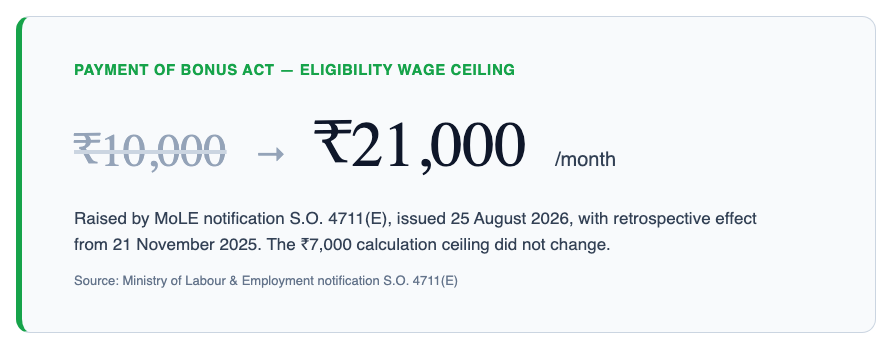
The part that's easy to conflate: the calculation ceiling — the salary figure the bonus percentage is actually applied to, capped at ₹7,000 a month or the applicable minimum wage, whichever is higher — did not move. So an employee earning ₹18,000 a month is now bonus-eligible under the new ₹21,000 ceiling, but their bonus is still calculated against the ₹7,000 figure, not their real salary. The bonus percentage itself is unchanged too: a statutory floor of 8.33%, payable even in a loss-making year, up to a maximum of 20% depending on allocable surplus. The 20-employee applicability threshold, the 30-day minimum service requirement, and the 30 November payment deadline (for an April-March financial year) all carried over from the old Payment of Bonus Act unchanged.
A working checklist for a 10-150 employee tech company
- Update the exit-process SOP so full and final settlement math is ready by the last working day, not weeks after — the two-working-day clock under Section 17(2) doesn't pause for a monthly payroll cycle.
- Check every fixed-term contract issued since 21 November 2025 against the one-year gratuity eligibility rule, and update the HR policy document that still says five years.
- If CTC structures lean heavily on allowances over Basic, re-check whether the 50%-of-remuneration wage floor changes the gratuity and PF base for anyone.
- Re-run bonus eligibility for every employee earning between ₹10,000 and ₹21,000 a month for FY 2025-26 — the retrospective effective date means some employees may be newly eligible for a bonus year that's already closed on paper.
- Confirm which supervisory employees actually fall inside the OSH Code's "worker" definition before publishing an overtime policy that assumes everyone qualifies.
Where Clan already reflects this
Clan's compliance checker flags gratuity and bonus eligibility against current thresholds rather than a policy document that hasn't been updated since before the codes took effect. The full and final settlement calculator and the gratuity calculator already build in the two-working-day settlement rule and the fixed-term gratuity exception described above, and the bonus calculator uses the ₹21,000 eligibility ceiling and ₹7,000 calculation ceiling as two separate inputs, not one. For a team closing out an exit under the new settlement clock, the relieving letter generator and experience letter generator draft the paperwork in the same sitting.
None of this replaces a labour lawyer's sign-off on your specific policy documents. But if your HR policy still cites five years for gratuity or ₹10,000 for bonus eligibility, that's not a future compliance risk — it's already the wrong number today.
Book a 15-minute walkthrough at clan.biz/demo to see how Clan handles this on your own payroll data, or start free at clan.biz/pricing.